

Property taxes in Thailand
- Published:
- Updated:
- By M2HomeHub
- 0 Comments
How not to overpay and legally reduce your rate
Recently, Thai condominium owners have begun to receive notices in large numbers to pay annual taxes. Many are faced with the fact that the calculation is made at the rate 0.3%, although they expected a significantly smaller amount. In this article, we will look at what the size of tax payments depends on and how a homeowner in Thailand can confirm their right to a preferential rate.
The difference between rates 0.02% and 0.3% - main criteria
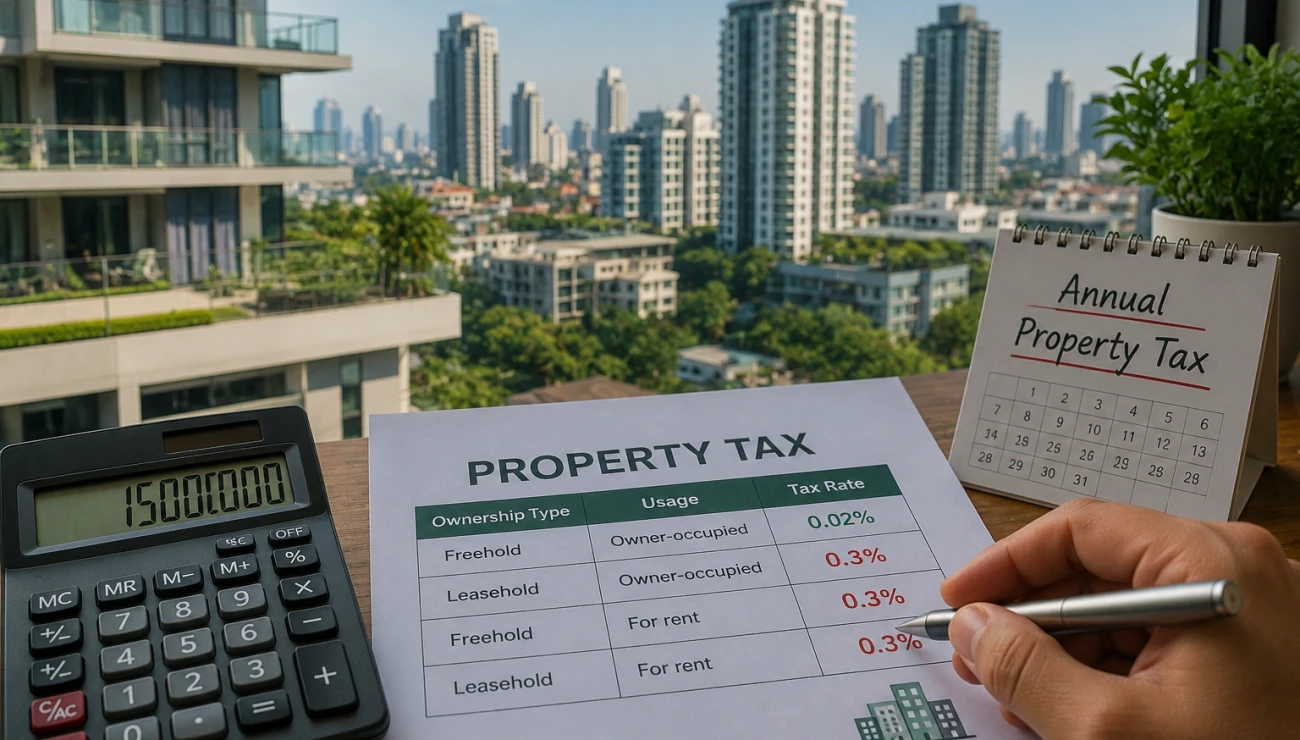
Thai tax legislation provides for a progressive scale, but for most properties worth up to 50 million baht, two main figures are relevant.
Who is entitled to the minimum rate of 0.02%?
It applies only if two conditions are met:
- Form of ownership - Freehold. If the apartment is in leasehold (long-term lease), the developer remains the legal owner, and the benefit does not apply to a private person.
- Personal use. The property must be used for the residence of the owner or his family members, and not for commercial profit.
Important: For apartments in Leasehold there is always a fixed rate 0.3%, regardless of whether you live there yourself or not.
How to transfer tax from 0.3% to 0.02% if you do not rent out housing?
If the tax service sent a receipt with the maximum coefficient, but you use the apartment only for yourself, this decision can be challenged. You will need to prove your personal residence.
The following are suitable arguments:
- A valid visa and passport stamps confirming your stay in the country.
- Registration history according to TM30 form.
- A certificate from the management company (Management Office) stating that the property was not rented out to third parties.
- Photos of the interior confirming your personal presence.
Yellow House Book (Tabien Baan): real benefit or myth?
There is an opinion that receiving a “yellow book” automatically zeros out taxes. This is not entirely true. The book itself only confirms your registration at the address, but not ownership.
However, it provides an important advantage:
If there is a yellow book and actual residence, the owner receives a tax deduction. First 10 million baht the value of real estate is not subject to tax.
If there is a yellow book and actual residence, the owner receives a tax deduction. First 10 million baht the value of real estate is not subject to tax.
Example for an apartment priced at 15 million baht:
- With the yellow book (live on your own): tax is paid only on 5 million (15 - 10 preferential). Amount to be paid: 1,000 baht.
- Without the yellow book (live on your own): tax 0.02% on the entire amount. Total: 3,000 baht.
- Rent or Leasehold: 0.3% rate applies. The tax will be 45,000 baht.
Results: is it worth registering for Tabien Baan?
The maximum savings from the yellow book is only 2,000 baht per year. Considering the complexity of the process (you need a long-term visa, the presence of Thai witnesses and time to go to the municipality), many owners prefer to simply pay the 0.02% rate without completing unnecessary paperwork.
Main rule: To avoid paying 0.3%, promptly notify the tax authorities that your apartment is your home and not a business asset.
Tags:
0 Comments
- No comments found